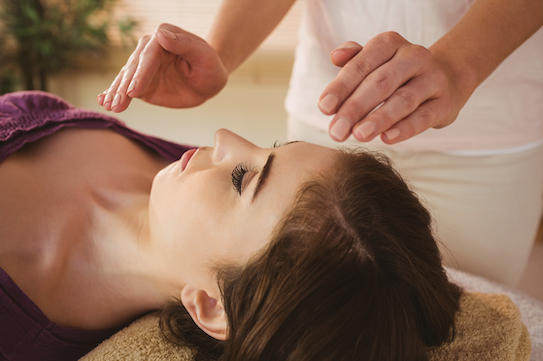
What are the ethical principles behind Reiki?

The five principles are:

Just for today …
do not worry
do not anger
be grateful
work hard
be kind to others.

Related Posts

  • Reiki – Mechanisms of Healing – Part 1

    In the past series on Reiki I discussed whether Reiki was a placebo, and cited a variety of scientific experiments to demonstrate it is not. Now I would like to discuss the mechanisms of healing. Like all other aspects of healing, the mechanism is little understood. So I would like to discuss the range of ideas concerning such mechanisms. At one end of this range, is the belief, held by many healers, that they are channelling a higher spiritual energy that ultimately derives from God. This energy is often referred to as “divine love” or “unconditional love” by healers. At the other end of the range there are many theories which are based on our knowledge of science, particular physics. The possibility that any conventional electromagnetic energy may be a candidate for “healing energy” seems unlikely as healing has been shown, at times to operate outside the dimensions of space & time. For example there are a wide variety of scientific experiments were healing procedures were partly or wholly undertaken at a distance1. Between these 'spiritual' and 'material' poles there is a middle ground of ideas concerning healing mechanisms based on the concepts of subtle energies, the subtle energy bodies of all living organisms and the universal energy known by names such as prana and chi. . I personally believe that I act as a channel for universal energy that comes from the natural world. References Dossey, L. (1993). Healing Words. The Power of Prayer and the Practice of Medicine. Harper Collins; New York.

  • Is Reiki a Placebo? – Part 1

    By nature Reiki is very intangible.   So in a series of blog articles I will try to explore how Reiki works and what the scientific research says. For me Reiki is merely a modern name for an ancient healing practice.  Which is administered by "laying on hands" and is based on the idea that an unseen "life force energy" flows through us and is what causes us to be alive. If one's "life force energy" is low, we are run down and then we are more likely to get sick or feel stress, and if it is high, we are more capable of being happy and healthy. The benefits of Reiki

    • Help some people to feel deeply relaxed
    • Help people cope with difficult situations
    • Relieve emotional stress and tension
    • Help to improve overall wellbeing
    • Help alleviate pain & anxiety
    My personal belief about how Reiki works, is that I act as a channel for Reiki energy and the client must be open to receiving it as the Reiki energy cannot “force” itself on to anyone.  As humans have free-will this means a client can block it if they consciously choose too.  The Reiki energy is then a resource that the human body can use to heal itself. So is Reiki just Placebo? A placebo is anything that seems to be a "real" medical treatment -- but isn't i.e. it is fake. The judgement is based on the availability of scientific evidence.  Dame Carol Black (– a former President of the Royal College of Physicians and of the Academy of Royal Colleges) and a group of distinguished doctors and scientists at the Kings Fund has concluded that current assumptions about what constitutes good scientific evidence for complementary therapies are too narrow. Professor Stephen Holgate who is also a member of the Kings Fund said: "As scientists, we have often sneered at the placebo effect. But as doctors, we know it can have a real impact on the outcomes of treatment for our patients. What is it, after all, but a trigger to the body's natural ability to heal itself?  That is something worth encouraging." I am a firm believer in the body's ability to heal itself.  As the aim of all complementary therapies is to stimulate the body to heal itself, they could all be considered placebo.  This is probably especially true of Reiki due to the fact that it has not been well studied scientifically.   The limited studies have not gathered enough evidence to “prove” Reiki energy exists, but this is not the same as proving it doesn’t exist. For me, it makes more sense to assess the impact of Reiki and Reiki energy.  After all if you can assess the impact of the energy then it must exist.  And as to, is it a placebo?  If the Reiki energy has an impact, it must exist, and it can’t be a placebo because its having an impact. So in my next blog I will at the scientific evidence on the impact of Reiki.
  • What is Reiki?

    Reiki is a Japanese healing practice for reducing stress and inducing the body to heal itself. Reiki, pronounced Ray Key, is a Japanese word which means free passage of universal life force energy.  This life force energy is known as Prana in India, Chi in China, Ki in Japan, Mana in Hawaii and Elan vital in Europe.  All of us have life force energy; it is essential for life and needs to flow freely for optimum health. The aim of Reiki treatments is to harmonise your life force energy and reconnect you to the universal energy.  Reiki energy is said to come from the source of all creation.  This Source is said to be the vital force that sustains the cosmos and infuses us with light and life, providing the energy source from which our bodies, and all forms of matter, arise.  Our aura is an energy body that surrounds our physical body; it emerges from our chakras (the energy centres of the body) and reflects the state of our life force energy. These concepts are the pillars on which all healing traditions including Reiki are built and can be found in the texts of ancient Chinese, Indian and Japanese philosophies.  More recently, modern scientific understanding has started to converge with this ancient wisdom.  Quantum physicists have discovered that the universe is made up of energy, the Zero Point Field, and this energy is the source of all matter in the universe including human beings.