
What is Reiki?
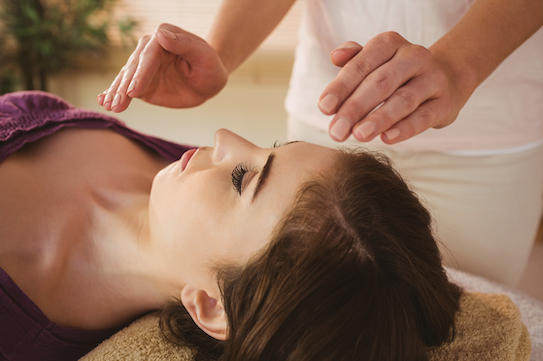
Reiki is a Japanese healing practice for reducing stress and inducing the body to heal itself.
Reiki, pronounced Ray Key, is a Japanese word which means free passage of universal life force energy. This life force energy is known as Prana in India, Chi in China, Ki in Japan, Mana in Hawaii and Elan vital in Europe. All of us have life force energy; it is essential for life and needs to flow freely for optimum health.
The aim of Reiki treatments is to harmonise your life force energy and reconnect you to the universal energy. Reiki energy is said to come from the source of all creation. This Source is said to be the vital force that sustains the cosmos and infuses us with light and life, providing the energy source from which our bodies, and all forms of matter, arise. Our aura is an energy body that surrounds our physical body; it emerges from our chakras (the energy centres of the body) and reflects the state of our life force energy.
These concepts are the pillars on which all healing traditions including Reiki are built and can be found in the texts of ancient Chinese, Indian and Japanese philosophies. More recently, modern scientific understanding has started to converge with this ancient wisdom. Quantum physicists have discovered that the universe is made up of energy, the Zero Point Field, and this energy is the source of all matter in the universe including human beings.
Related Posts
Is Reiki a Placebo? – Part 4
I know want to examine the scientific evidence of the impact of Reiki on more subjective issues like pain and anxiety. Heidt (1979) utilised healing to reduce levels of anxiety in patients in a hospital cardiovascular unit. Ninety volunteers were divided into three matched groups receiving treatments as follows: a five-minute period of healing, casual touch and no touch at all. Pre- and post-intervention levels of anxiety were measured using a special questionnaire. In those subjects receiving healing there was a highly significant reduction in anxiety following the treatment. Quinn (1982) also studied the effects of healing on anxiety states in hospitalised cardiac patients, but without making physical contact. Sixty patients were randomly assigned to either an experimental group receiving five-minute treatments of non-contact healing given by an experienced practitioner; or to a control group where inexperienced practitioners went through similar procedures whilst doing mental arithmetic. Assessments were done by the patients before and after treatment using a specialised questionnaire. Results showed that the experimental group had a very significant reduction in anxiety post-treatment. Gulak (1985), a healer, undertook a study on his patients measuring anxiety levels before and after healing treatment. Seventy six patients were given 15-minute treatments, with anxiety levels being assessed 14 days before and 21 days following the treatments using a specialised questionnaire. Different statistical analyses showed the reductions in anxiety to be significant as well as other health issues being cleared up. Wirth, Brenlan, Levine & Rodriguez (1993) performed a double-blind, crossover study on the effect of healing on post-operative pain, following surgical removal of both impacted lower molar teeth. Twenty one patients were randomly assigned to control or treatment groups before the first tooth was removed; and before the second operation the groups were transposed from control to experimental and vice versa. All conditions for both groups were the same except that the experimental groups received Reiki and healing post-operatively. Healing was undertaken at a distance of several miles from the patients with the healers concentrating on individual patients' photographs. Patients measured their pain intensity and pain relief over a period from 3 to 9 hours after operation using specialised pain assessment techniques. A statistically significant difference was found between the treatment and control groups in both pain intensity and amount of pain relief at hours 4 to 8 and hour 9. When combined, the data showed a highly significant improvement in pain levels as a result of the distant/remote healing. I started the series of articles by saying that Reiki is intangible. But in the last four articles I have demonstrated the impact on Reiki energy on human blood, yeast and plants as well as the human body. In addition there is clear evidence Reiki helps with pain, anxiety and lowering blood pressure. References Heidt, Patricia (1979). An Investigation of the Effect of Therapeutic Touch on the anxiety of Hospitalized Patients. Ph.D. dissertation, New York Univesity. See also: Heidt, Patricia (1981). Effects of therapeutic touch on the anxiety level of hospitalized patients, Nursing Res., 30, 30-37. Gulak, J. (1985). Lowering the anxiety levels in persons undergoing bioenergo-therapy. Psychotronika, 1985, 6-9. Quoted by Benor (1993). Wirth, D. P., Brenlan, D. R., Levine, R. J. & Rodriguez, C. M. (1993). The effect of complementary healing therapy on postoperative pain after surgical removal of impacted third molar teeth. Compl. Therap. Med., 1. 133-138.

Reiki – Mechanisms of Healing – Part 3
I want to finish the series of blog articles on the mechanisms of healing by looking at what happens in the client's body. Independent medical research has shown that this range of frequencies will stimulate healing in the body, with specific frequencies being suitable for different tissues. For example, 2 Hz encourages nerve regeneration, 7 Hz bone growth, 10 Hz ligament mending, and 15 Hz capillary formation. For example, it has been known for many years that placing an electrical coil around a fracture that refuses to mend will stimulate bone growth and repair. In addition Physiotherapy equipment based on these principles has been designed to aid soft tissue regeneration, and ultrasound technology is commonly used to clear clogged arteries and disintegrate kidney stones. Both Zimmerman (1990) in the USA and Seto (1992) in Japan further investigated the large pulsating biomagnetic field that is emitted from the hands of energy practitioners whilst they work. They discovered that the pulses are in the same frequencies as brain waves, and sweep up and down from 0.3 – 30 Hz, focusing mostly in 7 – 8 Hs, alpha state. Within the range of frequencies that will stimulate healing in the body. For me, all complementary therapies including Reiki work on the principle that they are stimulating the body to heal itself. References Zimmerman J, ‘The laying-on of hands, healing and therapeutic touch: a testable theory BEMI currents’, Journal of the Bio-Electromagnetics Institute. Vol 2, 1990. Seto A. et al., ‘Detection of extraordinarily large bio-magnetic field strength from human during external Qi emission’, Acupuncture and Electro-therapeutics Int. Jnl. Vol 17. 1992.
How was Reiki discovered?
Dr Mikao Usui is the father of Reiki. Born in Japan on 15th August 1864, he grew up hearing stories about the Buddha and was impressed with the Buddha’s quest for enlightenment. Dr Usui was fascinated by Buddha’s desire to help others and by the healing abilities he received after enlightenment. Looking at the people around him he saw that there were many people who were unable to lead happy, productive lives because they were sick or had physical disabilities. Out of a deep sense of compassion for these people, Dr Usui set off on a mission to acquire the healing powers that Buddha and his followers demonstrated, in order to help alleiviate sickness and suffering in others. Dr Usui travelled widely in Japan studying at Buddhist temples and trying to learn all he could about healing. His travelling eventually led him to a Zen monastery where he met Budhist monks and scholars who also interested in healing. After learning Sanskrit, while studying Indian sutras he discovered a formula for contacting a higher power that could bestow healing. By following the practices in the formula he was initiated into the use of the Reiki healing power. Dr Usui practiced and taught Reiki through attunements for the rest of his life.
