Is your inner elbow troubling you?
Pain or discomfort around your inner elbow is commonly known as Golfer’s elbow and also may be called Medial Epicondylitis. It is a repetitive strain injury caused by overuse of the forearm muscles i.e gripping, lifting and activities that involve repetitive forward bending of the wrist which may cause inflammation of your inner elbow.
With golfer’s elbow you may experience any or all of the following:
- Inner elbow pain on gripping, lifting or bending the wrist forward
- Inner elbow pain on opening jars/twisting movements of the wrist
- Localised tenderness on the inside of the elbow
- Stiffness on bending or straightening the elbow joint, particularly first thing in the morning
- Occasionally mild swelling and heat can be present
If your inner elbow is inflamed i.e. swollen or feels hot or is red then it will benefit from being iced. Apply ice packs to your elbow for 15 to 20 minutes at a time, three to four times while it is inflamed.
Based on my experience in clinic I have found that massage may assist you if you have Golfer’s elbow by releasing the tension in your forearms and increasing the flexibility of your forearms and increasing your pain free range of movement.
Equally important is making changes to your lifestyle by reducing aggravating activities to helping your recovery. To prevent a recurrence of golfers elbow it is important to stretch and strengthen your wrist flexors. To strengthen your wrist flexors, simply squeeze your hand for 10 seconds, release and then repeat ten times.
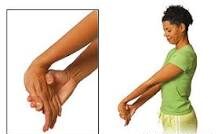
To stretch your wrist flexors extend your arm in front of you with your palm up, bend your wrist, pointing your hand towards the floor. With your other hand, gently bend your wrist farther until you feel a mild to moderate stretch in your forearm. Hold for a 30 to 60 seconds.
Related Posts

A potential alternative to antibiotics
I am sure you are aware of the current level concern about the rise of antibiotics resistance and the need to find new antibiotics or alternatives. So I read with interest that a traditional indian herb is being studied by scientists as an alternative to antibiotics. The herb, andrographis, which is known at the "king of the bitters" grows in India and Sri Lanka. It is thought to be responsible for combatting the Spanish flu epidemic that reached the Indian subcontinent in 1919. Researchers from the University of Southampton in the UK have recruited 20 primary care facilities to participate in a trail, which will be using andrograhpis supplements. It will be tested as a natural remedy against colds and flu - and treating these commong problems like these with antibiotics is bringing the era of drug-resistant superbugs closer to reality. Its a placebo-controlled study - which means patients could be given the real herb or a fake version - that will look at the herb's ability to treat acute coughs, sore throats and sinusitis. The study could lead the way for a larger study involving more patients with acute respiratory infections.
Pro’s and Con’s of our Shoulder Joint Design
While sometimes it may not feel like it, your shoulders are the most flexible joint in your body. The joint is formed by the union of the humerus, scapula (or shoulder blade) and the clavicle (or collarbone). While we normally think of it as a single joint, it is actually three joints
- glenohumeral joint
- sternoclavicular joint
- acromioclavicular joint.
- Work all joint articulations - if it moves that way, strengthen it.
- If you do a pushing exercise, counter it with a pulling exercise.
- Always use proper exercise form - control the resistance.