
Massage for Runners … its all about optimising recovery
We are introducing a new service: Runners Massage a special service to assist runners to optimise their recovery the massage will
- flush out all the waste products in the tired muscles
- address micro tears in the muscles
which rejuvenates the tired heavy muscles making them feel light.
The goal for runners is to first and foremost prevent the kind of wear and tear that comes with putting physical demands on your body. Yes; running is fantastic and ultimately good for your overall health, but if you are going to push your body to its limits you must prepare it and maintain it to avoid potential injury.
With strenuous running, your muscles can lose their ability to relax and they become shorter and tighter. Chronically tight muscles will lose their flexibility and that is really asking for trouble, as it makes you so much more susceptible to injury. If your muscles lose flexibility, they can easily pull or tear, and tight muscles become very sore. Blood flow is poor through tightened muscles (ischemia) and that also cause pain. Massage stretches the muscles in a much more specific way than stretching after a run, to regain lost flexibility.
Click here to book your runners massage
Related Posts

The Impact of Sitting All Day – Part 4
In part 1, I looked at the impact of sitting on your muscles, and in part 2 generally explored the impact on the rest of your body. In part 3 I focused on the impact of sitting on your circulatory system including your heart. In this article I will explore the impact of sedentary behaviour (sitting) and the link to cancer.
So how common is cancer? According to Cancer Research UKAnd here is the good news is more people survive cancer than die from it now.- Every two minutes someone in the UK is diagnosed with cancer.
- 1 in 2 people in the UK born after 1960 will be diagnosed with some form of cancer during their lifetime.
- Breast, lung, prostate and bowel cancers together account for over half of all new cancers each year.
- Overall cancer incidence rates in Great Britain have increased by more than a third since the mid-1970s, with almost this entire rise occurring before the late 1990s.
- 46% of men and 54% of women cancer patients diagnosed in 2010-2011 in England and Wales are predicted to survive 10 or more years.
- Cancer survival in the UK has doubled in the last 40 years.
Is a 15 minute Neck & Shoulder Massage beneficial?
Fifteen minutes is a very short space of time, so I am often asked by potential clients if they will receive any benefits from such a short massage. Well the good news is that you do receive benefits, and its not just me saying that, or the subjective experience of other clients there is scientific evidence too.
- In 1996 Shulman, K.R. & Jones, G.E. in the Journal of Applied Behavioural Science, looked at the effectiveness of chair massage in reducing anxiety in an organisation. An on-site chair massage therapy program was provided to reduce anxiety levels of 18 employees in a downsizing organization. 15 control group s participated in break therapy. Subjects’ stress levels were measured with the State-Trait Anxiety Inventory, which was administered twice during pretest, post-test, and delayed post-test to achieve stable measures. The study concluded that significant reductions in anxiety levels were found for the massage group. 1
- In 1996 Field, Ironson, Pickens et al. in the International Journal of Neuroscience concluded that chair massage therapy offers benefits in not just alleviating the physiological effects of anxiety, but also in improving mental alertness.2
- In 1997 Cady et al. in Perceptual & Motor Skills evaluated the effectiveness of a 15 minute chair massage on reducing stress as indicated by blood pressure. 52 employed participants' blood pressures were measured before and after a 15 minute massage at work. Analysis showed a significant reduction in participants' systolic and diastolic blood pressure after receiving the massage. High Blood pressure is associated with anxiety and stress, this study supports the conclusion that chair massage is relaxing and reduces stress. 3
- KR Shulman and GE Jones, 1996, The effectiveness of massage therapy intervention on reducing anxiety in the work place, Journal of Applied Behavioural Science (32), p160 – 173
- Field T; lronson G; Scafjdi F; Nawrocki T; Goncalves A; Burman I; Pickens J; Fox N; Schanberg S; Kuhn C, Sep 1996, Massage Therapy Reduces Anxiety and Enhances EEG Pattern of Alertness and Math Computations, The International Journal of Neuroscience, 86 (3-4) p197-205Read More: http://informahealthcare.com/doi/abs/10.3109/00207459608986710
- Cady SH and Jones GE, Feb 1997, Massage therapy as a workplace intervention for reduction of stress, Perceptual & Motor Skills, (1) p157- 158Read More: http://www.ncbi.nlm.nih.gov/pubmed/9132704
What is NMT or Neuromuscular Technique?
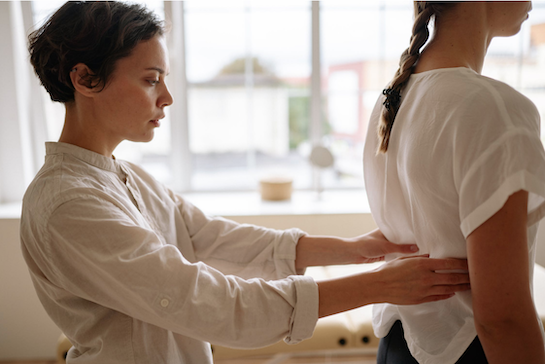
NMT (Neuromuscular Technique) is a soft tissue technique developed in the 1930's by Dr Stanley Lief. NMT is the application of quasi-static pressure perpendicular to the skin with the aim of releasing pain and tension in muscles (normally in skeletal muscles). Neuromuscular Technique is used by
- Physiotherapists
- Osteopaths
- Chiropractors
- Massage Therapists
- muscle spasms
- muscle tension
- aches & pains
- trigger points
