
More oops I did it again ….
We all wonder why after an injury or issue has healed and after several weeks of feeling pretty good, bang it flares up again, why? Last week I explained so factors influencing why this happens, now I want to explore the physiological aspects.
The Physiological Law of Facilitation (the path of least resistance) The law explains why old injuries flare up under stress.

When an impulse has passed once through a certain set of neurons in your brain to the exclusion of others, it will tend to take the same course on a future occasion, and each time it does, the resistance will become less.
An analogy of this would be the image of rain on a dirt hill each time it rains the pathway becomes more entrenched, larger, and more intricate spreading out to nearby pathways. So once a nerve learns a pain pattern it tends to repeat it even in the absence of the injury. So the effects of stress to your mind and body can be a trigger for this response to kick in.
But wait, there is good news!
The Law of Facilitation can be maneuvered to help a massage therapist make the benefits of their treatment last longer. You may be wandering how can this be? In massage, patterns of imbalance which result from trauma, or from habitually stressful patterns like poor posture can be addressed. So your body should adapt to changes taking place in the musculoskeletal system and create new pathways.
The body likes sameness, which produces habitual patterns. When a pattern is established, it does not take as much stimulation to activate the response.
Related Posts
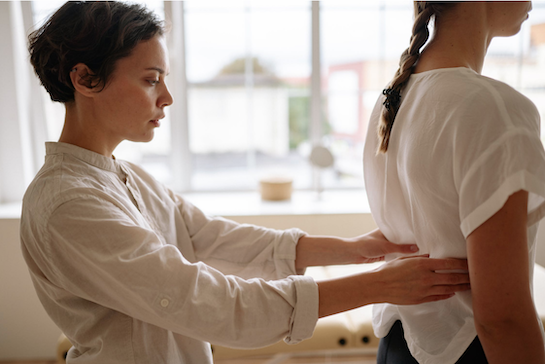
What is NMT or Neuromuscular Technique?
NMT (Neuromuscular Technique) is a soft tissue technique developed in the 1930's by Dr Stanley Lief. NMT is the application of quasi-static pressure perpendicular to the skin with the aim of releasing pain and tension in muscles (normally in skeletal muscles). Neuromuscular Technique is used by
- Physiotherapists
- Osteopaths
- Chiropractors
- Massage Therapists
- muscle spasms
- muscle tension
- aches & pains
- trigger points

Effect of a corporate chair massage program
I recently came across a scientific study in slovenia on the impact of a corporate chair massage program. As you can imagine, as I offer this service I was interested in the results of the study. Ninteen female volunteers who were aged between 40 - 54, were given chair massages on-site at their office twice per week for 1 month. They were all reporting various levels of aches and pains when they were working at their desks. The Cornell Musculoskeletal Discomfort Questionnaire was used to track and measure the aches and pains, while a goniometer was used to track and measure range of motion measurements for the neck and spine. The study showed a significant decrease for aches and pains in the neck and upper back. In addition, it found significant increase in range of movement for cervical lateral flexion of 28.8% (moving your neck so your ear goes towards your shoulder) and cervical extension (moving your head back). This study fits with me and my teams experience that after a Seated Acupressure Neck & Shoulder massages, clients are less tense, feel looser and are able to move their neck & shoulders more freely. Reference Sisko PK, Videmsek M, Karpljuk D, 2011, The effect of a corporate chair massage program on musculoskeletal discomfort and joint range of motion in office workers. J Altern Complement Med, 17(7):617-22

