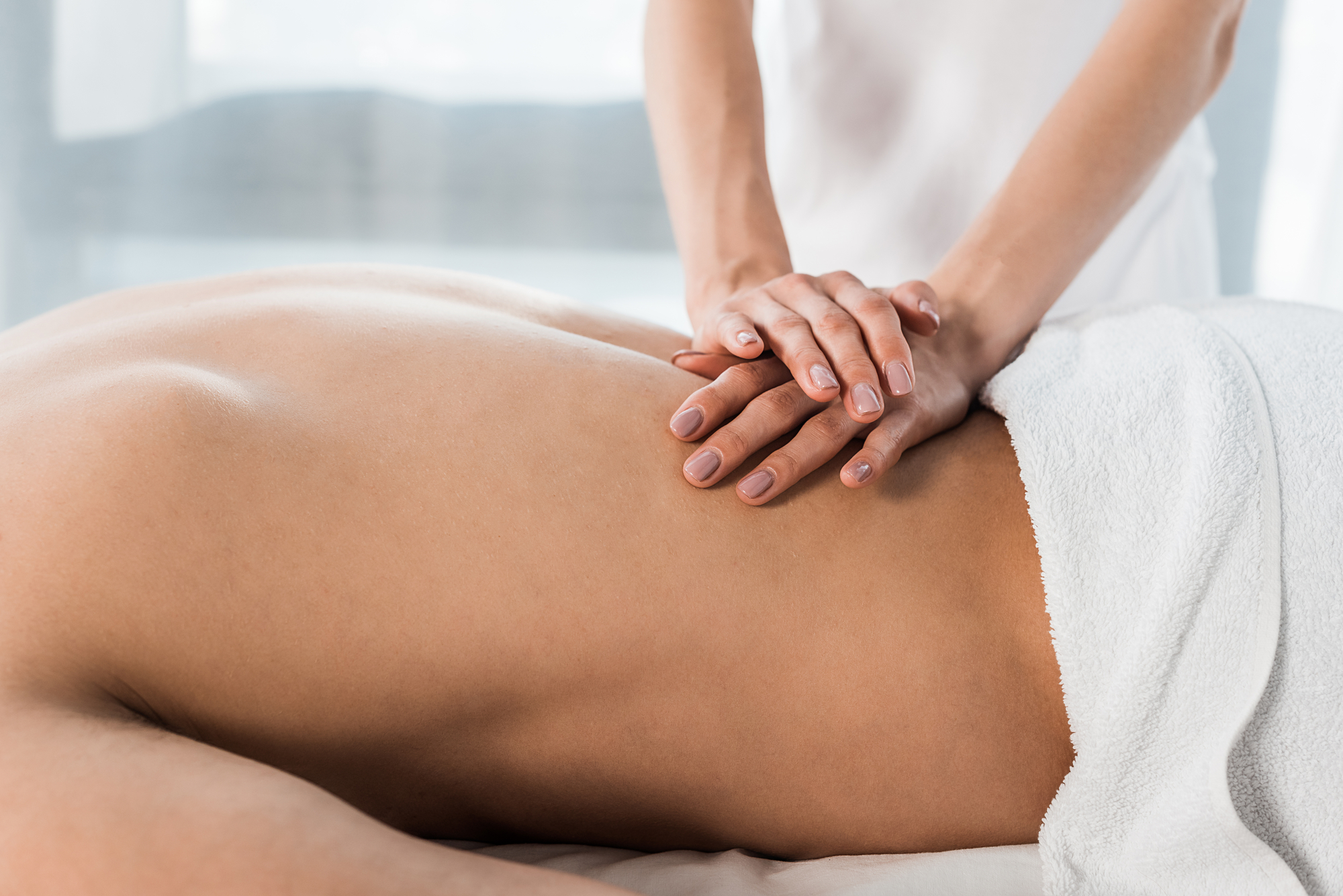
Why massage in the work place?

Obviously I am a firm believer of massage in the workplace, so I will start by acknowledging my bias on the topic.  What people may not know is that during the many years working in IT, I suffered from a verity of neck and shoulder issues.  This lead me to go to see a GP, chiropractor, osteopath and masseur.  While they all helped, what was most beneficial to me was regular seated acupressure neck & shoulder massage which helped me nip the tension and the problems in the bud.

We all know getting a massage feels great. Once your massages starts, the nerve cells in your skin send messages to your brain to release feel-good endorphins .  As a result stress hormones cortisol and adrenaline begin to decrease and the other all effect is to boost your mood and give you a natural high.  On a physical level the tension and tightness in the muscles begin to release.

This means your awareness shifts so your mind and body can function better.  Researches find your mind gets de-cluttered helping you to think more clearly, improve your alertness which leads to improve performance.

So why not book a massage see>> http://vitalitytherapy.co.uk/booking

Related Posts

  • What happens to your intervertebral discs when you sit?

    Sitting in office chairs for long periods of time not only affects your muscles but impacts the disks in your spine. In humans over 5 years of age, there is no direct blood supply to the jelly like nucleus of the intervertebral discs. The intervertebral discs therefore rely upon fluid inflow and outflow for their nutrition: when you lie down, the pressure comes off the discs and they expand, absorbing water and nutrients as they do so (rather like a sponge expanding and sopping up a spill on the floor). Unloaded Disc Filling with nutrient rich liquid Disk_Unloaded When you stand up, the discs are compressed and their watery component is squeezed out, thus removing waste products at the same time. Loaded Discs Being Compressed Disk_Loaded Similar squeeze/expand cycles are occurring every time that we move, both day and night. This means you must move in order to “feed” your discs and keep them healthy. The disc squeeze/expand cycle is crucial to spinal health.  It is well proven that your degenerative disc "disease" progresses faster over time if your discs can't alternate compression with expansion.  As sitting more than half the time at work is associated with herniated discs (or slipped discs) and sciatic nerve pain in those older than 35, so try to get up and move as much as possible.

  • Back Stretches

    These stretches can either be done as a complete series or individually.  The aim of stretching is to relax the muscles so it should never be painful. Each stretch should be held for 15 seconds and repeated twice.  Ideally you should stretch daily. Back

    • Clasp elbows in front of your body at shoulder height, making big circles in front of you - push out and look down.  This will stretch your upper back.
    • Lie on your back and raise your legs with your knees bent and hands palms down at right angles to your body.  Move your legs over to one side of your body keeping your knees together and bent.  Repeat for the other side of your body.
    • Lie on your back with your arms at right angles to your body.  Raise a leg with your knee bent and let it drop over to the other side of your body.  Now repeat on the other side.
    • Kneel on all fours, then sit back with your buttocks on your heels and your head on the floor and your hands outstretched in front of you (child pose for those who know yoga).  This will stretch your entire spine.
    • Kneel on all fours, look down whilst arching your back upwards (like a cat) hold for 15 seconds, then slowly drop your back down and stretch your head up and hold for 15 seconds.
    • Lie on your back with your right knee up keeping your foot on the ground.  Place your left ankle on your right knee, letting your left knee drop outwards.  Clasp your hands below your right knee and pull towards your body, this will stretch out your gluteals.   Now repeat on the other side.
    • Lie on your stomach with your arms by your side and gently raise your head slightly.  If these feels comfortable then you can also raise your feet of the ground and raise your arms above your head in from of you.  This is very strengthening and especially good for people with straight backs.
         
  • The Impact of Sitting All Day – Part 3

    In part 1, I looked at the impact of sitting on your muscles,  and in part 2 I started to explore the impact on the rest of your body.  In this post I continue to explore the impact of sitting on your circulatory system including your heart. Heart Disease When sitting for prolonged periods of time, muscles burn less fat and blood flows more sluggishly, allowing fatty acids to more easily clog the heart.  In 2012 Ford & Caspersen in their research paper, Sedentary behaviour and cardiovascular disease: a review of prospective studies (International Journal of Epidemiology, Vol 41, No 5 pages 1338 - 1353) showed that the people with the most sedentary time are more than twice as likely to have cardiovascular disease than those with the least. In 2012 Zedric and Hamilton found that just a few hours sitting suppresses a gene that helps keep your cardiovascular system healthy by controlling inflammation and blood clotting. T W Zedric & M T Hamilton, 2012 Identification of hemostatic genes expressed in human and rat leg muscles and a novel gene (LPP1/PAP2a) suppressed during prolonged physical inactivity (sitting), Lipids in Health and Disease, Vol 11 see http://www.biomedcentral.com/content/pdf/1476-511X-11-137.pdf Cholesterol Sitting also means that your large postural support muscles are inactive.  When active these muscles produce a quite of beneficial molecules.  One molecule skeletal muscles produce is an enzyme called lipoprotein lipase - which you can think of as a vacuum cleaner for fats in the blood stream.  A study in rats showed that after 24 hours forced inactivity, their lipoprotein lipase acitivity was reduced by 90 - 95%, which led to a 75% drip in the ability of their muscles to remove fats from their bloodstream as will as a significant decrease in "good" (HDL) cholesterol. L Bay & Mark Hamilton, 2003, Suppression of skeletal muscle lipoprotein lipase activity during physical inactivity: a molecular reason to maintain daily low-intensity activity, Journal of Physiology, Vol 551, No 2 pages 673 - 682.See http://onlinelibrary.wiley.com/doi/10.1113/jphysiol.2003.045591/full