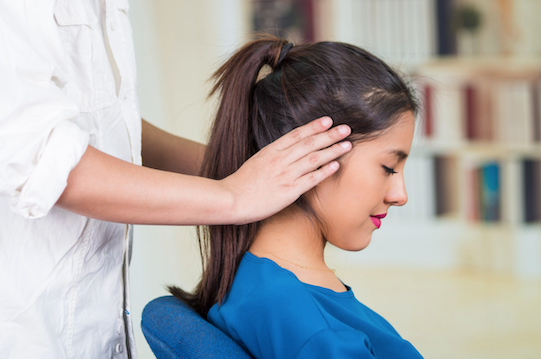
Why do we sometimes recommend longer treatments?
In my last blog article, I explained the benefits including scientific evidence from a 15 minute Seated Acupressure Massage. So if 15 minutes has all these benefits, why do we offer 30 minute treatments and why do we sometimes recommend them?
Quite simply, its based on experience. I find that some clients start to notice their neck & shoulder loosing mobility and their level of muscular tension increasing but they are too busy to book in. Frequently we find that people leave it 3 weeks before they book in or sometimes up to a month, by which time the knots have multiplied and grown!!!
The 15 minute treatment is designed to nip things in the bud, before the tension gets chronic. However I appreciate that my clients have very busy lifestyles so this isn’t always possible so we offer longer treatments.
Finally, some people get home from work and instantly switch off while other people take a while. This different rate of response is what we as therapists see when we treat people, so we recognise when your muscles are releasing really slowly. Indeed over the years some of my clients have commented on how it took a long time for their right/left shoulder to relax. In cases where your muscles are releasing very slowly we often suggest you book a longer treatment.
Related Posts

Can massage help you if you are constipated?
Recently scientists have looked at the impact of abdominal massage on people with constipation. Constipation affects twice as many women as men. Older people are more likely to be affected and in addition taking certain medications e.g. opioids can cause it. A randomised control trail of 204 patients with constipation (from opioid medication), were split into two equal groups. The intervention group were taught how to administer abdominal massage on themselves, in a clockwise direction over the intestines on the abdominal wall, which they performed twice a day for four weeks after breakfast & dinner. The control group received standard medical care, such as laxatives, suppositories and enemas. Both groups were asked to keep a diary of their bowel movements and to complete three questionnaires, including the Bristol stool scale for evaluating stools and bowel habits, the visual analogue scale, which contains questions about constipation, including severity, straining & pain. Patients in the massage group reported significant improvements in stool consistency, straining during defecation, the feeling of incomplete emptying after defecation and experienced increase bowel movements. They also reported a reduction in the severity of constipation, pain, straining, gas & fullness in the rectum. However, the massage had no effect on the stool amount. The researchers concluded that abdominal massage was an effective approach for managing opioid induced constipation. So if you suffer from constipation consider abdominal massage. Reference https://www.ncbi.nlm.nih.gov/pubmed/31358243
What are postural muscles?
Postural muscles are also referred to as core stability muscles, are found deep in the body. The first muscles that typically come to mind with posture are the muscles along the spine. The erector spinae muscles run along the bones of your spine, the vertebrae, from your neck all the way to your tailbone. These muscles hold the spine in extension or upright, counteracting the pull of gravity. Abdominal muscles support the structures at the front of your trunk, balancing the pull of your back extensors. The quadratus luborum muscles at the top of your pelvis help stabilize the pelvis and spine in the lower back in an upright position. The purpose of postural muscles is to keep good posture in the field of gravity. These muscles consist mostly of slow-twitch muscle fibres and have a greater capacity for prolonged use but are prone to over working. This means if you have poor posture or you have long periods of sitting immobile your postural muscles get tired and they become weak and less efficient. The longer the situation continues the more likely you are to develop postural imbalances and they finally you get knots and pain!