
What can help my sciatica?
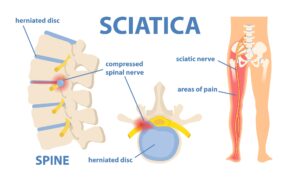
- Sudden numbness or muscle weakness in a leg.
- Pain after a violent injury, such as a traffic accident.
- Trouble controlling bowels or bladder
It’s not always possible to prevent sciatica, and the condition can come back. To protect your back:
- Exercise regularly. To keep the back strong, work the core muscles — the muscles in the abdomen and lower back needed for good posture and alignment. A healthcare professional can recommend activities.
- Keep good posture when sitting. Choose a seat with good lower back support, armrests and a swivel base. For better low back support, place a pillow or rolled towel in the small of the back to keep its normal curve. Keep knees and hips level.
- Use your body correctly. When standing for long periods, rest one foot on a stool or small box from time to time. When lifting something heavy, let your legs do the work. Hold the load close to your body. Don’t lift and twist at the same time. Find someone to help lift heavy or awkward things.
- Ensure you say adequately hydrated. This will assist the discs in your back.
Related Posts

Arm and Hand Stretches
These stretches can either be done as a complete series or individually and most of them can be done at your desk. Some will ease tension in specific parts of the body whilst others are generally relaxing. Please remember stretching should always be relaxing and never painful! To get maximum benefit from these stretches you should do them daily and hold each stretch for 15 seconds and repeat twice unless otherwise stated. Arm and Hand Stretches
- Stand with your feet together, keeping you feet together and your knees soft. Raise your arms alternatively swinging them over your head as if you were performing backstroke.
- Raise your left arm above your head and push up as high as you can. Feel the stretch down the left side of the body. Hold for 30 seconds. Repeat on the right.
- Raise your right arm to the side, keeping at shoulder height. Point your fingers towards the ceiling and push your palm away from your body. Hold for 30 seconds and repeat on left side.
- With your right hand by your side, point your fingers behind you with your palm facing up. Push your right shoulder and wrist towards the floor, then make a fist. Hold. Repeat on the other side.
- Keep your arms by your side and clench your fists as tight as you can, then spread your thumb and fingers as far apart as possible.
- Let your arms hang loosely by your side and shake them for about 15 seconds.
So how does massage help “tired” muscles?
Many clients come to our clinics a few days after vigorous work outs or competing in sporting competition because their legs feel tried or heavy. These clients often book a sports massage, but is their any scientific evidence to explain what is happening in the body during the treatment? Massage dilates superficial blood vessels and increases the rate of blood flow. In addition if a deeper pressure is used like in sports or deep tissue massage on a healthy adult it improves the venous return. Both of these changes to the blood flow represent a potent means to accelerate healing. For example, it suggests that massage should improve the performance of fatigued muscles. In addition, Goats asserts that massaged muscle fibres display less spasm, an increased force of contraction and enhanced endurance compared with muscles simply rested. Which suggests that massage will assist in the improvement of sporting performance where it has been compromised. References Scull CD (1945) Massage - Physiologic Basis. Archive of Physical Medicine 26: 159-67 Wilkins RW, Halperin MH, Litter J. (1950) The effects of various physical procedures on circulation in human limbs. Ann Intern Med 33: 1232-45 Goats GC (1994) Massage - the scientific basis of an ancient art: part 2. Physiological and therapeutic effects Br J Sp Med 28(3)
Introduction to magnesium
Of all supplements right now there seems to be a buzz around magnesium so I wanted to explore its role in the body. I first became aware of magnesium over a decade ago when my nutritionalist put me being a chocoholic down to a lack of magnesium. It's then that I discovered that magnesium can ease PMS and chocolate is a good source of magnesium. So for all women out there that eat chocolate at certain times of the month, like I used to, don't beat yourself up, it may be like me and your body is crying out for magnesium. Magnesium is a mineral that is not just important for the body it is ubiquitous. It is crucial to:
- Nerve transmission
- Muscle contraction
- Blood coagulation
- Energy production
- Nutrient metabolism
- Bone and cell formation
- osteoporosis
- high blood pressure
- clogged arteries
- hereditary heart disease
- diabetes
- strokes
