Is your neck stiff?

Neck pain or a stiff neck is characterised by stiffness or pain when turning or moving the head or neck. Neck stiffness is a common problem which usually gets better after a few days or weeks.

The neck contains muscles, tendons, ligaments, and the cervical spine.   These work together to support the head and allow it to move in many directions. A stiff neck may become painful when a person tries to move their neck or head.

A stiff neck often occurs when one of the muscles becomes strained or tense.  Common causes of neck pain or stiffness are:

  • Sleeping awkwardly.
  • Sitting or slouching for long periods, such as at a desk.
  • Looking down at an object (such as a mobile phone) repeatedly.
  • Experiencing a fall.
  • Sustaining a sports injury.
  • Having tense neck muscles due to stress or pressure.
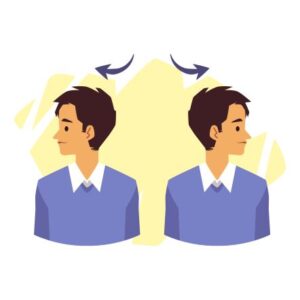
Neck Rotation

A stiff neck is one of the conditions that will benefit from stretching. While keeping the back straight and shoulders still, gradually turn the head to the left as far as it can naturally go without increasing pain. Once the head has reached its rotation limit, hold the stretch for 5 seconds before bringing it back to neutral position.

A stiff neck, along with stiff shoulders it is one of the most common triggers for booking a massage. The reason is that massaging in the neck muscles may alleviate the tension and improve the blood flow to your neck.

Related Posts

  • Why does massage help so much?

    In a previous post I outlined some of the benefits of the 15 minutes Seated Acupressure Neck & Shoulder massage including the scientific evidence for these claims. But I think their is one benefit that stands out above these.

    I know in my previous life as an IT project manage, several times I spent most of a day trying to fix a problem and I just couldn't find a solution.  I had a tendency to get caught up in a problem and its just frustrating -- it can literally stress you out. When you're stressed out, it's harder to think clearly. Emotional stress can send your problem-solving skills into a tailspin.  To make matters worse I used to flip over that fine line between being focused on solving the problem and obsessing over it.

    The trick to break this cycle is to shift your focus. The purpose of shifting your focus is to temporarily get your mind off whatever challenge has it tied up in knots.   So when you come back to it you have are re-energised and have a fresh perspective.

    Going for a massage, shifts your focus to your body releases anxiety and the seated acupressure massage energises you & improves your mental alertness.  So I found it an ideal way of breaking the cycle of mentally obsessing over problems when I worked in IT.

     
  • What happens to your muscles when you sit?

    SittingMusclesChair sitting is unique in that Gluteus maximi are totally relaxed at the same time as having an upright torso, and they are therefore not able to contribute to lumbar extension and back stabilization as they usually do. Without the help of the Gluteal muscles, the Erector Spinae muscles above become tired and painful in a very short time, and give up fighting to maintain the correct "hollow" in the lumbar spine. The diagram on the left indicates what happens to three key muscles when you spend long periods of time sitting. The Hamstrings (H) are shortened by sitting.  Also, during sitting, the Gluteus Maximus (GM) is relaxed and unable to tension the lumbosacral fascia.  This means the Errector Spinae (ES) muscle group must therefore perform the entire lumber extension workload. This article discusses the link between lower back pain and the following muscle problems:-

    1. Shortening of the hamstring muscle.
    2. Overworking of the Erector Spinae muscle group and the development of trigger points.
    3. Overworking of the Iliopsoas muscle group and the development of trigger points.
    Hamstrings are shortened and inactive while sitting causing tension.  This is so common I will write a separate blog most on Hamstrings. Without the help of the Gluteal muscles the Erector Spinae muscles become tired and painful very quickly and struggle to maintain the correct "hollow" in your lower back.  Even thought you may consider sitting an apparently restful posture it is actually an intense workout for the Erector Spinae and the Iliopsoas muscle groups. If you are not using a full and appropriately shaped chair back, your Iliopsoas muscles must pull your torso forward to stop you falling backward, and they have to do that at the short end of their range of contractile length. That is a sure fire recipe for Iliopsoas muscle shortening and development of trigger points. Here are some indications that you have a shortened Iliopsoas
    • Diffuse achy - type pain radiating out from the groin area to the lower back, and possibly around to the side of the hip and the butt area. If the trigger points in the groin are not pressed, the pain is not sharp or stabbing.
    • Relief of pain is often experienced by sitting down.
    • Worse upon lengthening the iliopsoas, i.e. when one stands up, or straightens the hip joint.
    • Worse for doing situps.
    • Worsened by externally rotating the hip (i.e. making the knee cap look outward) when the hip joint is fully extended.
    • In patients with sciatic nerve pain, lying flat on one's back with the legs out straight causes the trigger point tightened iliopsoas to compress the lumbar vertebrae together, with the result that the nerve roots of the sciatic nerve are compressed too.
    • When lying flat on one's back, doing a straight leg raise reveals weakness on the affected side.
    • In patients with sciatic nerve pain due to nerve root compression, lying flat on one's back with legs out straight stretches that trigger point tightened iliopsoas. The result is that the iliopsoas compresses the lumbar vertebrae together, and the the nerve roots of the sciatic nerve are compressed at the same time.
    All the side effects of sitting for long periods of time can be addressed by deep tissue massage.
  • Cryotherapy

    We all know that sports stars take ice baths and I am often asked why they do it, and do I need to do it after I run.  So today I am going to answer that question. Cryotherapy is one of long accepted tools of a sports masseur.  If you have ever watched a football match on telly, you will have seen someone fall to the ground and the coach run on with a bucket of water and the magic sponge and the player then hopefully gets up and hobbles around before taking an active part in the game.  So the magic sponge, (the application of cold water to an injured area) is Cyrotherapy in its most basic form.  The local application of ice or cold water is beneficial because

    • It relieves pain
    • Reduces muscle spams (i.e. athletes take ice baths to avoid feeling stiff the next day)
    • When someone is injured it moderates inflammation
    Probably equally important to all those benefits is that the treatment is very convenient, inexpensive and effective. So to go back to the questions should I have an ice bath after training. If you have injured yourself during training you should definitely follow the RICE (Rest Ice Compression and Elevation) protocol
    • Rest - by which I mean avoid weight bearing activities and anything that causes pain for 24 - 48 hours.
    • Ice - Use either cold water or ice wrapped in a tea towel and apply for 2 - 20 minutes for 2-3 days then 3 times daily.    When applying ice you go through the cold, aching, burning and numbness sensation cycle, it is very important to stop at numbness to avoid burning yourself.
    • Compression  - use a compression bandage if necessary
    • Elevation - if the injury is to a limb, elevate it to help it heal.
    The only exception to using Ice for injuries is for people with a peripheral vascular disease e.g. diabetes, anyone who is hypersensitive or has a physiological aversion to cold if you are frail or if you have varicose veins in the injured area or  the injury is a broken bone. However, what if you haven't injured yourself, should you have an ice bath after training.    Taking an ice bath or sometimes a cold-water immersion is certainly now more popular amongst athletes than ever before.   The key reason is that as it reduces muscle tightness and soreness and it allows athletes to recover more quickly after intense training.   The big draw back is that is uncomfortable and not really scientifically proven.  My recommendation would be only to do it if you are training really intensively and you are not contraindicated (see above exceptions to using ice) and want to, as ice baths are optional.  For me the most important thing to prevent injury and allow you to recover quickly is a well designed training plan where you build up the intensity of the exercise slowly, with adequate warm up routine and a cool down routine and stretching. Remember if you do get injured or have tight muscles after training, a good masseur will be able to sort these out.