Is the outside of your elbow troubling you?
Following on from my blog last week on inner elbow issues, I want to talk about outer elbow pain or discomfort.
Pain or discomfort around your outer elbow is commonly known as Tennis elbow and also may be called Lateral Epicondylitis. It is a repetitive strain injury caused by overuse of the forearm muscles which may cause inflammation of your outer elbow.
With tennis elbow you may experience any or all the following:
- Outer elbow pain on gripping small objects.
- Outer elbow pain on opening jars or turning a door handle.
- Localised tenderness on the outside of the elbow.
- Stiffness on bending or straightening the elbow joint.
- Occasionally mild swelling and heat can be present.
If your outer elbow is inflamed i.e. swollen or feels hot or is red, then it will benefit from being iced. Apply ice packs to your elbow for 15 to 20 minutes at a time, three to four times while it is inflamed.
Based on my experience in clinic I have found that massage may assist you if you have tennis elbow by releasing the tension in your forearms and increasing the flexibility of your forearms and increasing your pain free range of movement.
Equally important is making changes to your lifestyle by reducing aggravating activities to helping your recovery. To prevent a recurrence of tennis elbow it is important to stretch and strengthen your wrist extensors.
To strengthening your wrist extensors Rest your forearm on a table. Hang your wrist and hand off the edge. Hold a light hand weight or a can of beans. Moving only your wrist, raise the weight. Hold for 10 seconds then slowly lower it. Repeat this x10.
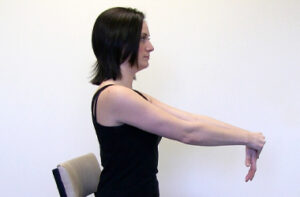
To stretch you wrist extensors, straighten your arm fully. Relax your wrist so that you leave your hand hanging. With your other hand, gently push against the back of your hand so it bends towards you until you feel a moderate stretch along the top of your arm. Hold for 30 to 60 seconds.