What happens to your muscles when you sit?
 Chair sitting is unique in that Gluteus maximi are totally relaxed at the same time as having an upright torso, and they are therefore not able to contribute to lumbar extension and back stabilization as they usually do. Without the help of the Gluteal muscles, the Erector Spinae muscles above become tired and painful in a very short time, and give up fighting to maintain the correct “hollow” in the lumbar spine.
The diagram on the left indicates what happens to three key muscles when you spend long periods of time sitting.
The Hamstrings (H) are shortened by sitting. Also, during sitting, the Gluteus Maximus (GM) is relaxed and unable to tension the lumbosacral fascia. This means the Errector Spinae (ES) muscle group must therefore perform the entire lumber extension workload.
This article discusses the link between lower back pain and the following muscle problems:-
- Shortening of the hamstring muscle.
- Overworking of the Erector Spinae muscle group and the development of trigger points.
- Overworking of the Iliopsoas muscle group and the development of trigger points.
Hamstrings are shortened and inactive while sitting causing tension. This is so common I will write a separate blog most on Hamstrings.
Without the help of the Gluteal muscles the Erector Spinae muscles become tired and painful very quickly and struggle to maintain the correct “hollow” in your lower back. Even thought you may consider sitting an apparently restful posture it is actually an intense workout for the Erector Spinae and the Iliopsoas muscle groups.
If you are not using a full and appropriately shaped chair back, your Iliopsoas muscles must pull your torso forward to stop you falling backward, and they have to do that at the short end of their range of contractile length. That is a sure fire recipe for Iliopsoas muscle shortening and development of trigger points. Here are some indications that you have a shortened Iliopsoas
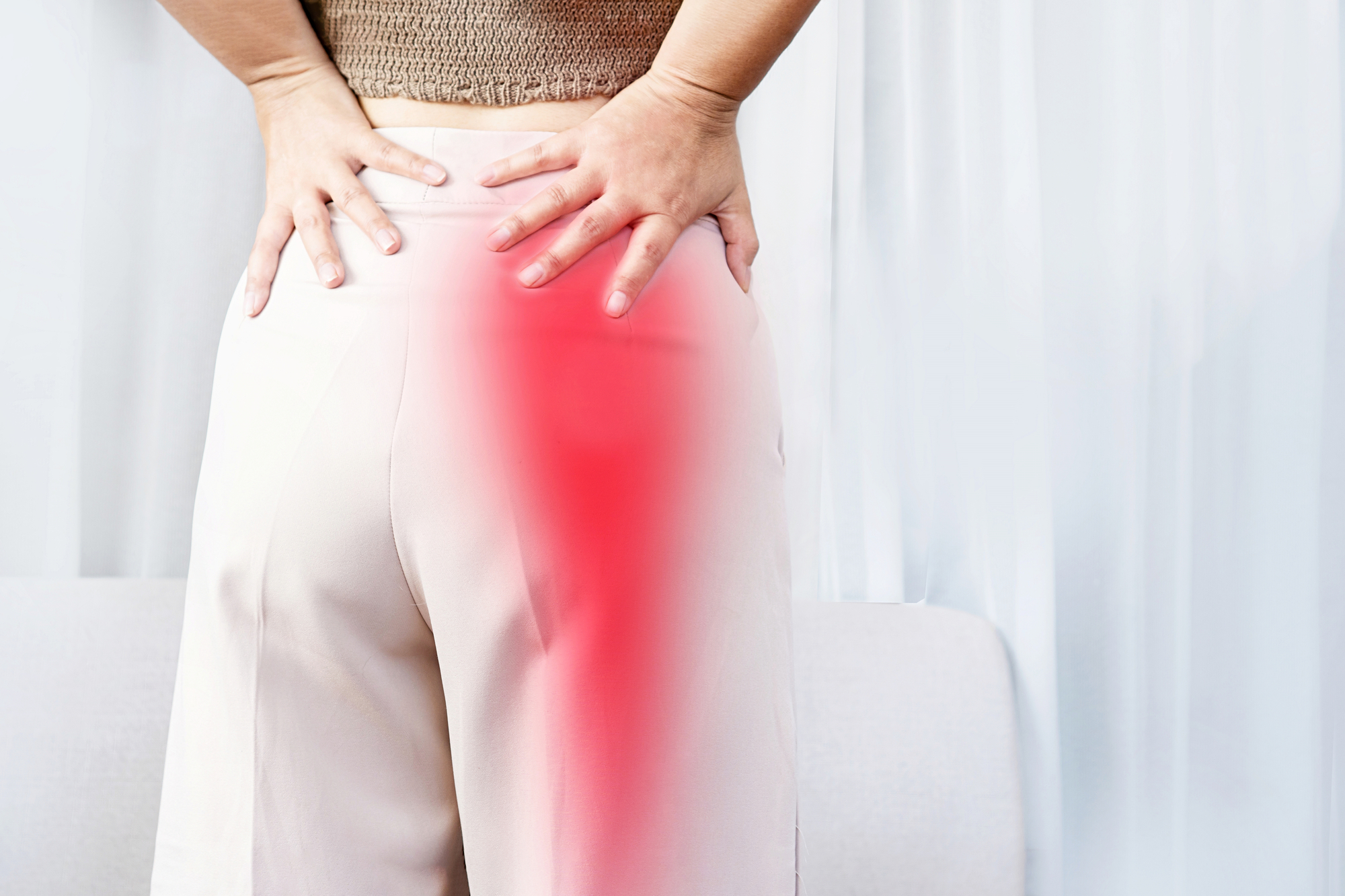
- Diffuse achy – type pain radiating out from the groin area to the lower back, and possibly around to the side of the hip and the butt area. If the trigger points in the groin are not pressed, the pain is not sharp or stabbing.
- Relief of pain is often experienced by sitting down.
- Worse upon lengthening the iliopsoas, i.e. when one stands up, or straightens the hip joint.
- Worse for doing situps.
- Worsened by externally rotating the hip (i.e. making the knee cap look outward) when the hip joint is fully extended.
- In patients with sciatic nerve pain, lying flat on one’s back with the legs out straight causes the trigger point tightened iliopsoas to compress the lumbar vertebrae together, with the result that the nerve roots of the sciatic nerve are compressed too.
- When lying flat on one’s back, doing a straight leg raise reveals weakness on the affected side.
- In patients with sciatic nerve pain due to nerve root compression, lying flat on one’s back with legs out straight stretches that trigger point tightened iliopsoas. The result is that the iliopsoas compresses the lumbar vertebrae together, and the the nerve roots of the sciatic nerve are compressed at the same time.
All the side effects of sitting for long periods of time can be addressed by deep tissue massage.
Related Posts

Elbow Pain
Recently we have treated a few cases of elbow pain.
 There are two common site for elbow pain, the outside edge of the elbow which is often an indication of tennis elbow or lateral epicondylitis and the inside edge of the elbow which is often an indication of glofer's elbow or medial epicondylitis. With both of these conditions the pain may radiate up the arm and / or down along the forearm.
Both conditions can be caused by precise wrist movements from using a mouse or keyboard. As the name suggests tennis elbow can be caused by faulty backhand technique when playing tennis. While golfer's elbow can be caused by poor technique when playing Golf or faulty forehand technique when playing tennis.
In addition tennis elbow can be caused by carrying heavy shopping bags as it causes tension in the wrist extensors.
Most of the cases we see are caused by long hours using computers. The first thing we do is try and establish the cause of the pain, which can be tightness or spasm in the muscles of the forearm, neck or shoulders and then treat accordingly. We can also show you simple stretches to stretch out the muscles of the forearm.
What surprised us, and prompted me to write this blog is that they all the clients had just assumed that elbow pain was something that they just had to lived with. In all the cases we dramatically reduced the pain and in most cases after a few treatments the clients were pain free! So don't sit their in pain, book a massage.
There are two common site for elbow pain, the outside edge of the elbow which is often an indication of tennis elbow or lateral epicondylitis and the inside edge of the elbow which is often an indication of glofer's elbow or medial epicondylitis. With both of these conditions the pain may radiate up the arm and / or down along the forearm.
Both conditions can be caused by precise wrist movements from using a mouse or keyboard. As the name suggests tennis elbow can be caused by faulty backhand technique when playing tennis. While golfer's elbow can be caused by poor technique when playing Golf or faulty forehand technique when playing tennis.
In addition tennis elbow can be caused by carrying heavy shopping bags as it causes tension in the wrist extensors.
Most of the cases we see are caused by long hours using computers. The first thing we do is try and establish the cause of the pain, which can be tightness or spasm in the muscles of the forearm, neck or shoulders and then treat accordingly. We can also show you simple stretches to stretch out the muscles of the forearm.
What surprised us, and prompted me to write this blog is that they all the clients had just assumed that elbow pain was something that they just had to lived with. In all the cases we dramatically reduced the pain and in most cases after a few treatments the clients were pain free! So don't sit their in pain, book a massage.