
How does Reflexology work?
Different areas of the feet (or reflex areas) correspond to different parts of the body and the whole body is represented. By working on these reflex areas, a balancing effect can be brought about in the corresponding part of the body. The right foot corresponds to the right side of the body and the left foot to the left side. By working on both feet the whole body can be brought back into harmony.
Related Posts

What is the history of Reflexology?
A 2,300 B.C wall painting in the tomb of Ankmahor, known as the physicians’ tomb, shows a series practitioners giving patients reflexology treatments. In addition, there is evidence that reflexology was known to some early African tribes and the American Indians. Dr William Fitzgerald and American ENT (ear nose and throat) consultant rediscovered it in the early 1920s. He found that by applying pressure to reflex points on the feet, he could anaesthetize a patient’s ear and this enabled him to perform minor ear operations. Eunice Ingham, a nurse, publicised much of Dr Fitzgerald’s research by treating patients, lecturing and training practitioners including Dorean Bayley who introduced the therapy into England in the early 1960s.
Does reflexology improve quality of life at end of life?
With a 50% chance of a cancer diagnosis and a 50% chance of surviving cancer, cancer will touch all our lives. Cancer Research statistics
- 1 in 2 people born after 1960 in the UK will be diagnosed with some form of cancer during their lifetime.
- 50% survive cancer for 10 or more years.
- appetite
- breathing
- constipation & diarrhea
- fears of the future
- pain
- nausea
- sleep
- communication
- tiredness
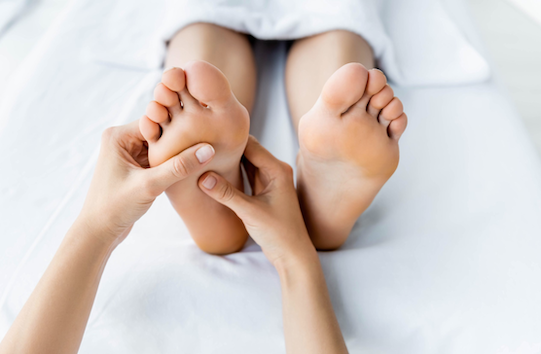
How can Reflexology help me?
As a human being, you are a complex, delicately balanced machine that is synergistic … everything working together for the benefit of the whole person. When each part of you, mind, body and soul works in harmony, you feel at your peak. At a biological level, this harmony is achieved by a myriad of glands, organs, nerves, chemicals etc. and if one of these gets out of balance then the effects are felt throughout the whole body. Reflexology restores your inner harmony and instils a sense of well being. It treats the whole person and can be used to tackle a wide range of conditions such as pre-menstrual tension, headaches, migraines, sinus problems, anxiety, tension, insomnia, digestive disorders, backache, stiffness and tension.
