
What can I expect during a Reflexology session?
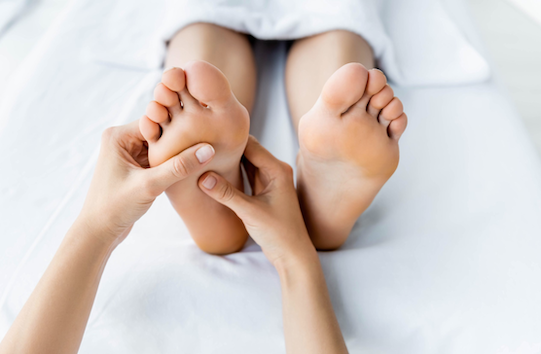
A reflexology session lasts one hour. The client sits with bare feet while the therapist applies pressure by hand to all areas of both feet. Imbalances in the body are detected as tender spots on the feet and normally these become less tender after a few minutes massage. However, it may not possible to remove all tender areas with one treatment.
Related Posts
How can Reflexology help me?
As a human being, you are a complex, delicately balanced machine that is synergistic … everything working together for the benefit of the whole person. When each part of you, mind, body and soul works in harmony, you feel at your peak. At a biological level, this harmony is achieved by a myriad of glands, organs, nerves, chemicals etc. and if one of these gets out of balance then the effects are felt throughout the whole body. Reflexology restores your inner harmony and instils a sense of well being. It treats the whole person and can be used to tackle a wide range of conditions such as pre-menstrual tension, headaches, migraines, sinus problems, anxiety, tension, insomnia, digestive disorders, backache, stiffness and tension.

Reflexology and Pain Management – Part 1
Pain is a fact of life, it is a necessary part of being human. Pain is a universal experience that serves the vital function of triggering avoidance. Pain is not a simple sensory experience, it can occur even in the absence of tissue damage. It involves emotional, social and cognitive beliefs. The four pillars of pain include
- Peripheral nervous system or the movement system
- Autonomic system, composing the sympathetic, parasympathetic, hormonal and visceral systems
- Central nervous system
- Psycho-emotional aspects, such as stress, anxiety, fear, social life and memory of pain.
Can reflexology help you with period pain?
It is claimed that up to 50% of women of reproductive age suffer from period pain. For many years from my mid-teens until my late twenties I suffered from dysmenorrhea (period pain). To avoid it interfering with my O Levels I went on the pill but discovered that didn't suit me. In my mid-twenties I tried reflexology and I felt it helped but I never knew if it was just as a I got older my periods were less painful. Recently I came across some research that supports my experience. A clinical trial in Iran compared the effectiveness of reflexology and ibuprofen in reducing period pain intensity and duration. 68 students with period pain were randomly divided into a reflexology group, receiving 10 reflexology sessions (40 minutes each) during two consecutive menses cycles or an ibuprofen group, receiving 400mg of ibuprofen every eight hours for three days during three consecutive menses cycles. The study results indicated that reflexology was superior to ibuprofen in reducing period pain and the effects off treatment continued even after discontinuing the intervention in the third mense cycle. Reference Valiani M, Babaei E, Heshmat R and Zare Z, Comparing the effects of reflexology methods and ibuprofen administration on dysmenorrhea in female students of Isfahan University Medical Sciences. Iran Journal of Nursing and Midwifery Research. December 2010; 15 (S1): 371 - 378
