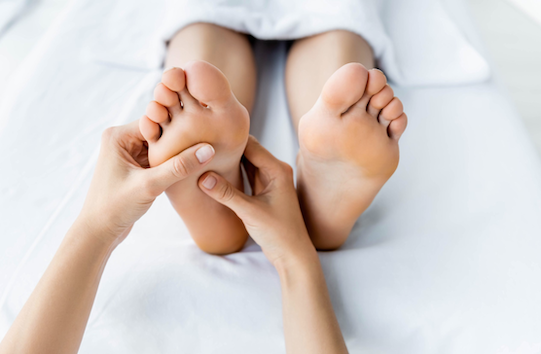
How many Reflexology sessions will I need?
It is difficult to predict how many treatments are required to re-balance the body but in general, the patient should see some evidence of improvement after three treatments. In general, the longer a patient has had a condition the more treatments will be required.
Some patients have monthly Reflexology treatments to help them manage their stress levels and as part of a preventative self-care programme.
Related Posts

Reflexology and Pain Management – Part 2
In part 1, I explored what pain was, the pain response and briefly explained how reflexology helps manage pain. Much anecdotal evidence shows the benefits of reflexology in pain management and several studies indicate successful treatment outcomes including pain reduction. (See references at end of article). However I would like to focus on one recent study by Dr Carol Samuel and Dr Ivor Ebenezer of University of Portsmouth as this is the first time Reflexology has been scientifically evaluated as a study for acute pain. The results indicate that reflexology may be as effective as pain killers for common conditions such as osteoarthritis, backache and cancer. Participants attended two sessions, in which they were asked to submerge their hand in ice water. In one of the sessions they were given reflexology before they submerged their hand, and in the other session they believed they were receiving pain relief from a Tens machine, which was not actually switched on. The use of the Tens machine is equivalent of a sugar pill in drug trials. The researches found that people felt about 40% less pain, and were able to stand pain for about 45% longer, when they used reflexology as a method of pain relief. So if you are in pain now, by not book a reflexology session. References Booth L (1997) Vertical Reflex therapy: results of a reflexology trail in a Bristol residential home for elderly Khan S, Otter S and Springett K (2006) The effects of reflexology on foot pain and quality of life in a patient with rheumatoid arthritis: a case report, The Foot 16 pg 112-116 Brown CA and Lido C (2008) Reflexology treatment for patients with lower limb amputations and phantom limb pain: an exploratory pilot study, Complementary Therapies in Clinical Practice 14 pg 124-131 Hughes CM, Smyth S and Lowe-Strong A (2008) Reflexology for the treatment of pain in people with multiple sclerosis: a double-blind randomised controlled trail, The Journal of Alternative and Complementary Medicine 14(1) S1-S109

Reflexology: Scientific Evidence of it’s effects physiological anxiety signs
Recently a scientific study (see details below) was published which evaluated the physiological anxiety signs and sedation needs of patients in intensive care units in a Turkish hospital.
Background It is an accepted medical fact that when it is necessary to mechanically ventilate patients in intensive care units of hospitals, the patients experience stress and anxiety. It is standard medical practice to relieve anxiety, pain, agitation with sedatives to ensure patient comfort. Sedatives however also have side effects causing high blood pressure, slow heart beat, coma, respiratory depression, muscle weakness and atrophy, increased risk of pneumonia, kidney problems and immunosuppression. It may also prolong the need for ventilation which in turn increases the risk of complications. Method 60 patients were split into two groups one of which was the control group. Sedation (Propofol) was reduced 30 min before treatment (or no treatment) which resulted in patients with mixed consciousness to which the outcome measure was administered. This was the American Association of critical care nurses sedation assessment scale (AACNSAS) and the vital signs recorded. Reflexology applied to ears, hands and feet bilaterally was given twice a day for a total of 30 minutes per day, over 5 days. The reflexology focussed on the brain, cortex, hypothalamus, hypophysis and subcortex; areas though to influence anxiety, agitation and stress response. No reflexology was given to the control group but the sedation was reduced and all the same measurements were taken. Results The physiological signs of anxiety and stress i.e. blood pressure, heart rate and respiratory rate were are reduced in the group that received reflexology on each of the 5 days. In addition there was a reduction in the requirement for sedatives in the group that received reflexology. Conclusions These findings ‘show that reflexology is an effective treatment in reducing the physiological signs of anxiety and stress in patients receiving mechanically ventilated support.’ This study provides scientific evidence to underpin the idea that reflexology has a beneficial effect on anxiety and stress.Title: Reflexology: It’s effects on Physiological Anxiety Signs and Sedation Needs Journal: Holistic Nursing Practioner Authors: E. Korhan, L. Khorshid, M Uyar Reference: 2014; 28 (1);6-23 Study Type: Randomised Controlled Trial - with control group receiving no treatment