
More factors that contribute to muscle cramps
Previously I discussed how dehydration & lack of sodium or potassium may cause muscle cramps. I now want to explore other nutritional factors.
Calcium
Calcium plays an essential role in muscle contractions. Some active people report their problem with cramping disappears when they boost their calcium intake. This anecdotal evidence is disputed by scientists who state that when dietary deficiencies of of calcium occur, calcium is released from the bones to provide what the body needs for proper muscle contraction. If you are plagued by muscle cramps, it may be worth trying to increase your intake of dairy or other calcium rich foods to see if it helps.
Magnesium
Just as muscles need calcium to contract they need magnesium to relax. Roffe et al demonstrated that magnesium helps reduce leg cramps that occur in the middle of the night.
Reference
Roffe C1, Sills S, Crome P, Jones P (2002), Randomised, cross-over, placebo controlled trial of magnesium citrate in the treatment of chronic persistent leg cramps. Med Sci Monit. 2002 May;8(5): p326-30.
Related Posts
How to test if you have good posture
We all know that we need good posture. So today I wanted to share with you how to test if you have good posture.
The Wall Test - Stand with the back of your head touching the wall and your heels six inches from the baseboard. With your buttocks touching the wall, check the distance with your hand between your lower back and the wall, and your neck and the wall. If you can get within an inch or two at the low back and two inches at the neck, you are close to having excellent posture. If not, your posture may need professional attention to restore the normal curves of your spine.
The 'Jump' Test - Feel the muscles of your neck and shoulders. Do you find areas that are tender and sensitive? Are the buttock muscles sore when you apply pressure? What about the chest muscles?
If any of your muscles feel tight, sore or achy then why not book in for a massage.

What happens to your muscles when you sit?
 Chair sitting is unique in that Gluteus maximi are totally relaxed at the same time as having an upright torso, and they are therefore not able to contribute to lumbar extension and back stabilization as they usually do. Without the help of the Gluteal muscles, the Erector Spinae muscles above become tired and painful in a very short time, and give up fighting to maintain the correct "hollow" in the lumbar spine.
The diagram on the left indicates what happens to three key muscles when you spend long periods of time sitting.
The Hamstrings (H) are shortened by sitting. Also, during sitting, the Gluteus Maximus (GM) is relaxed and unable to tension the lumbosacral fascia. This means the Errector Spinae (ES) muscle group must therefore perform the entire lumber extension workload.
This article discusses the link between lower back pain and the following muscle problems:-
Chair sitting is unique in that Gluteus maximi are totally relaxed at the same time as having an upright torso, and they are therefore not able to contribute to lumbar extension and back stabilization as they usually do. Without the help of the Gluteal muscles, the Erector Spinae muscles above become tired and painful in a very short time, and give up fighting to maintain the correct "hollow" in the lumbar spine.
The diagram on the left indicates what happens to three key muscles when you spend long periods of time sitting.
The Hamstrings (H) are shortened by sitting. Also, during sitting, the Gluteus Maximus (GM) is relaxed and unable to tension the lumbosacral fascia. This means the Errector Spinae (ES) muscle group must therefore perform the entire lumber extension workload.
This article discusses the link between lower back pain and the following muscle problems:-
- Shortening of the hamstring muscle.
- Overworking of the Erector Spinae muscle group and the development of trigger points.
- Overworking of the Iliopsoas muscle group and the development of trigger points.
- Diffuse achy - type pain radiating out from the groin area to the lower back, and possibly around to the side of the hip and the butt area. If the trigger points in the groin are not pressed, the pain is not sharp or stabbing.
- Relief of pain is often experienced by sitting down.
- Worse upon lengthening the iliopsoas, i.e. when one stands up, or straightens the hip joint.
- Worse for doing situps.
- Worsened by externally rotating the hip (i.e. making the knee cap look outward) when the hip joint is fully extended.
- In patients with sciatic nerve pain, lying flat on one's back with the legs out straight causes the trigger point tightened iliopsoas to compress the lumbar vertebrae together, with the result that the nerve roots of the sciatic nerve are compressed too.
- When lying flat on one's back, doing a straight leg raise reveals weakness on the affected side.
- In patients with sciatic nerve pain due to nerve root compression, lying flat on one's back with legs out straight stretches that trigger point tightened iliopsoas. The result is that the iliopsoas compresses the lumbar vertebrae together, and the the nerve roots of the sciatic nerve are compressed at the same time.

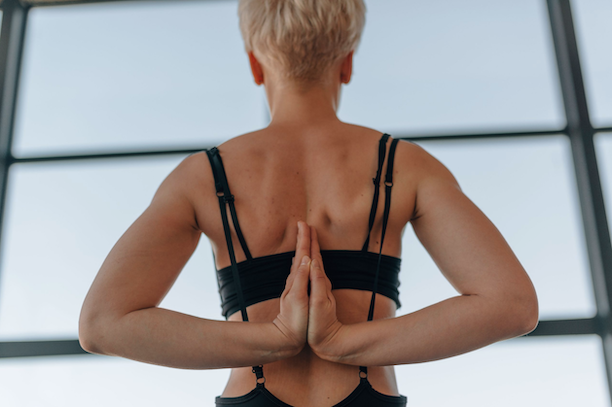
Can Yoga help if you have fibromyalgia?
We all struggle to get our heads around things from time to time. For me I find it hard to imagine living with Fibromyalgia, the constant pain, which moves around the body and the tiredness. In addition to the physical symptoms there is the additional mental strain of living with a chronic condition that is has no visible signs and can change from day to day. A pilot study recruited 22 women who had been diagnosed with Fibromyalgia to participate in a 75 minute yoga class twice weekly for eight weeks. Questionnaires were used to track pain, anxiety and depression they were completed pre, mid and post intervention. In addition salivary cortisol samples were taken three times a day pre and post intervention. The results indicate that a "yoga intervention" may
- Reduce pain
- Reduce catastrophising
- Increase acceptance
- Increase mindfulness
- Alter total cortisol levels

